“Multi-thread more” is the most common piece of deal advice, and one of the least useful.
Deals don’t get stuck because you didn’t meet enough humans. They get stuck because you didn’t meet the right stakeholder groups, in the right order, for the right purpose, and didn’t intentionally build those people into coaches and champions.
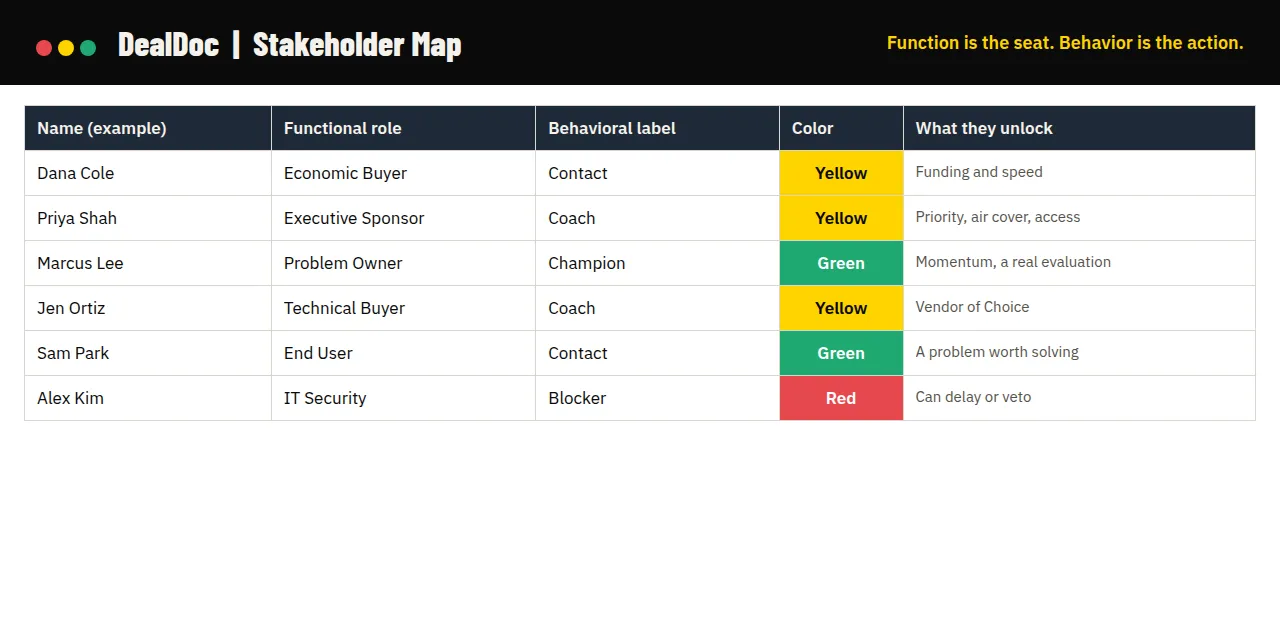
This template maps stakeholders as a system, not a list.
What’s in the template
Stakeholder Map tab. One row per person, with two labels each:
- Functional role (dropdown): Economic Buyer, Executive Sponsor, Problem Owner, Technical Buyer, End User or other influencer. This is the seat.
- Behavioral label (dropdown): Contact, Coach, Champion or Blocker. This is the action. Everyone starts as a Contact.
Plus a red, yellow or green color, what they unlock, their needs, the outcomes you solve for them, why they should support the decision, the evidence of their behavior, and the next action with an owner and a date.
Stakeholder Gates tab. The five gates every complex deal has to unlock, what each one owns and unlocks, and what happens if it’s missing:
| Gate | Unlocks | If missing |
|---|---|---|
| End Users | A problem the business will take seriously | The pain stays abstract, so it never becomes “big enough” |
| Problem Owner | Internal momentum, sponsorship and a real evaluation | It never bubbles up, so nothing gets owned |
| Technical Buyer | Vendor of Choice | You can’t shape or win criteria, so you lose to “safer” or “better” |
| Executive Sponsor | Priority, air cover, access and leverage | You don’t lose to a competitor, you lose to other priorities |
| Economic Buyer | Funding and speed | Everyone agrees, but no money moves |
Champion Test tab. The observable behaviors that separate a champion from a friendly coach, grouped under the three things a champion must be: someone with access to power who’s willing to use it, someone selling for you when you’re not there, and someone you’ve tested.
How to Use tab. Definitions of every role and label, and the five-step routine below.
How to use it
- Pick your top five deals.
- Fill in the map: names, functional role, behavioral label, the needs they have, the outcomes you solve for them, and why they should support the decision.
- Answer the hard questions. What stakeholders am I missing? What’s the story from the field that makes this unignorable? What’s the path from the middle to the top? Do I really have a champion? Have I shaped the decision criteria with the technical buyer? Who will be my executive sponsor?
- Color code each stakeholder and each gate red, yellow or green.
- For every red or yellow, pick one play and put an owner and a date on it.
Stop thinking, “Who else should I meet?” Start thinking, “Which gate is still locked, and what does it unlock?”
What green looks like
Green is a documented, validated stakeholder coalition. Functionally, you have a mobilized problem owner, an active executive sponsor, a verified economic buyer path (who signs, approval tiers, discretionary thresholds), and technical buyers aligned and signing off on you.
Behaviorally, they’re using influence, not just offering opinions. If you don’t have a mobilized problem owner and an executive sponsor showing champion behaviors, you can’t be green. You may have support. You don’t have the force required to create change.
Two labels people get wrong
Champion. It isn’t a person you find. It’s a behavior: someone spending political capital to advocate for change with your solution. Being friendly isn’t championing. Sharing information is coaching. And you likely won’t see real champion behavior until mid-to-late stage. More in What Is a Champion in Sales?
Economic Buyer. It isn’t always the CFO. It’s whoever can create or allocate the budget at your price point. Change the number and you can change who the Economic Buyer is. More in Economic Buyer vs Technical Buyer vs Champion.