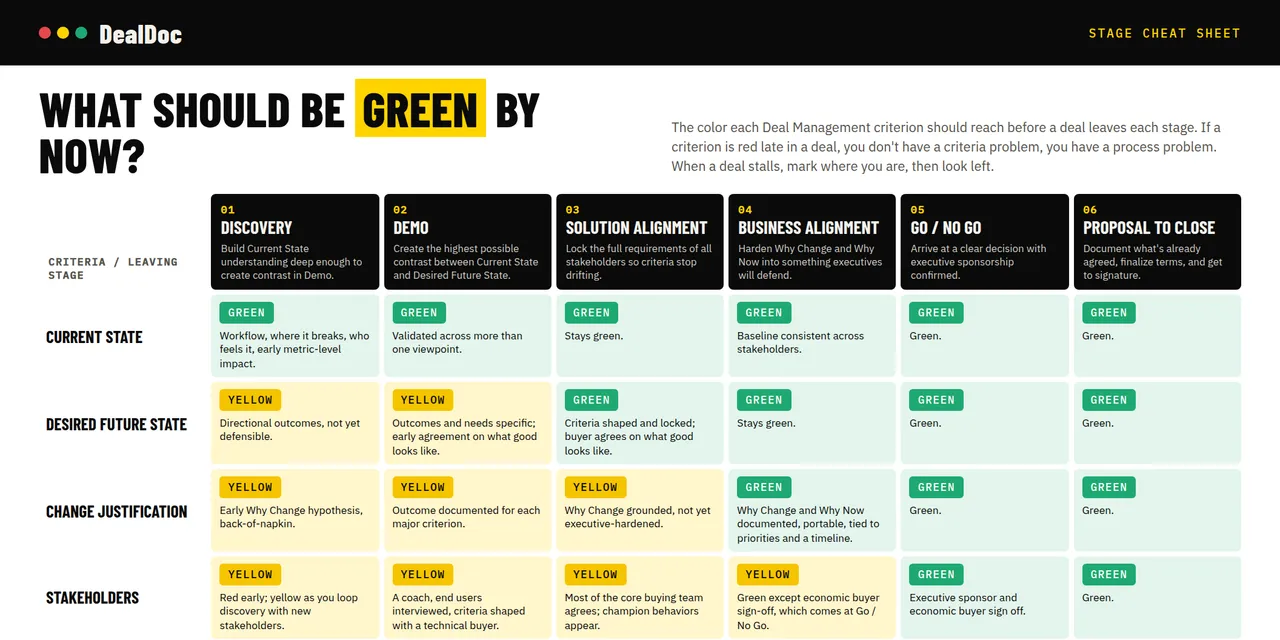
Green doesn’t mean the same thing in Discovery that it means in Negotiation.
Early in a deal, you’re building a foundation. Late in a deal, you’re confirming it held. So the real question in any deal review isn’t “is this green?” It’s “is this as green as it should be by now?”
This one-page cheat sheet answers that for every stage.
What’s on the sheet
A grid of the six Deal Management criteria (Current State, Desired Future State, Change Justification, Stakeholders, Buying Process and Competition) against six stages: Discovery, Demo, Solution Alignment, Business Alignment, Go / No Go, and Proposal to Close.
Each cell shows the target color for leaving that stage and a one-line note on what that means. The bottom row gives you a pulse-check question for each stage, so you can test whether the stage actually did its job before you move on.
The targets at a glance
| Leaving… | Current State | Desired Future State | Change Justification | Stakeholders | Buying Process | Competition |
|---|---|---|---|---|---|---|
| Discovery | Green | Yellow | Yellow | Red, moving to Yellow | Red | Red or Yellow |
| Demo | Green | Yellow | Yellow | Yellow | Yellow | Yellow |
| Solution Alignment | Green | Green | Yellow | Yellow | Yellow | Green |
| Business Alignment | Green | Green | Green | Yellow | Yellow | Green |
| Go / No Go | Green | Green | Green | Green | Yellow | Green |
| Proposal to Close | Green | Green | Green | Green | Green | Green |
A few that surprise people:
- Current State should be green before you leave Discovery. If the buyer won’t continue without seeing something, run a combined discovery and demo, then a reverse demo. But don’t skip the baseline.
- Red on Buying Process after Discovery is fine, unless it’s a fast-moving inbound deal. Buying process questions asked too early can sound like you’re trying to close a deal that doesn’t exist yet.
- Stakeholders don’t go green until Go / No Go, when the executive sponsor and economic buyer sign off.
- Buying Process is the last to go green. It turns green when you’re in procurement and the legal and commercial path is mapped: who signs, in what order, and what happens if redlines come back.
How to use it
When a deal stalls, mark where you are on the sheet. Then look left, at the stage you just came from, and ask whether the criteria that should have been resolved by now actually were, or whether you moved forward on assumption. Most stalled deals show a yellow or red that was visible two stages ago and ignored.
In 1:1s and deal reviews, use it as the shared standard. A red in the right place can be completely appropriate. A leader’s job is to check the stage against the targets before challenging a color, and then ask for the plan.
Instead of strict CRM exit criteria. I’m not a fan of bogging down the CRM with painful gates. It just teaches sellers to click boxes. When the color coding rhythm runs well, you don’t need forced exit criteria at all.
The pulse checks
One question per stage to test whether it did its job:
- Discovery: “Is what I described actually the problem, or are there layers underneath we haven’t gotten to yet?”
- Demo: “Based on what you’ve seen, does the solution justify changing now that everyone would support?”
- Solution Alignment: “If we locked the solution requirements today, is there anyone who’d push back on what we’ve agreed to?”
- Business Alignment: “When the economic buyer or executive sponsor looks at this, what’s the first question they’re going to ask?”
- Go / No Go: “At this point, is there any reason this doesn’t move forward?”
- Proposal to Close (from the paper-process lessons): “Before we start the redline process, are there any terms in your standard agreement that other vendors have pushed back on or found unusual?”
The stages on this sheet follow the sales process from the book, with Proposal, Negotiation and Close combined into one column, including the two alignment stages most processes skip. If your stages have different names, map them to the closest column. More on those stages in The Two Sales Process Stages Nobody Builds.