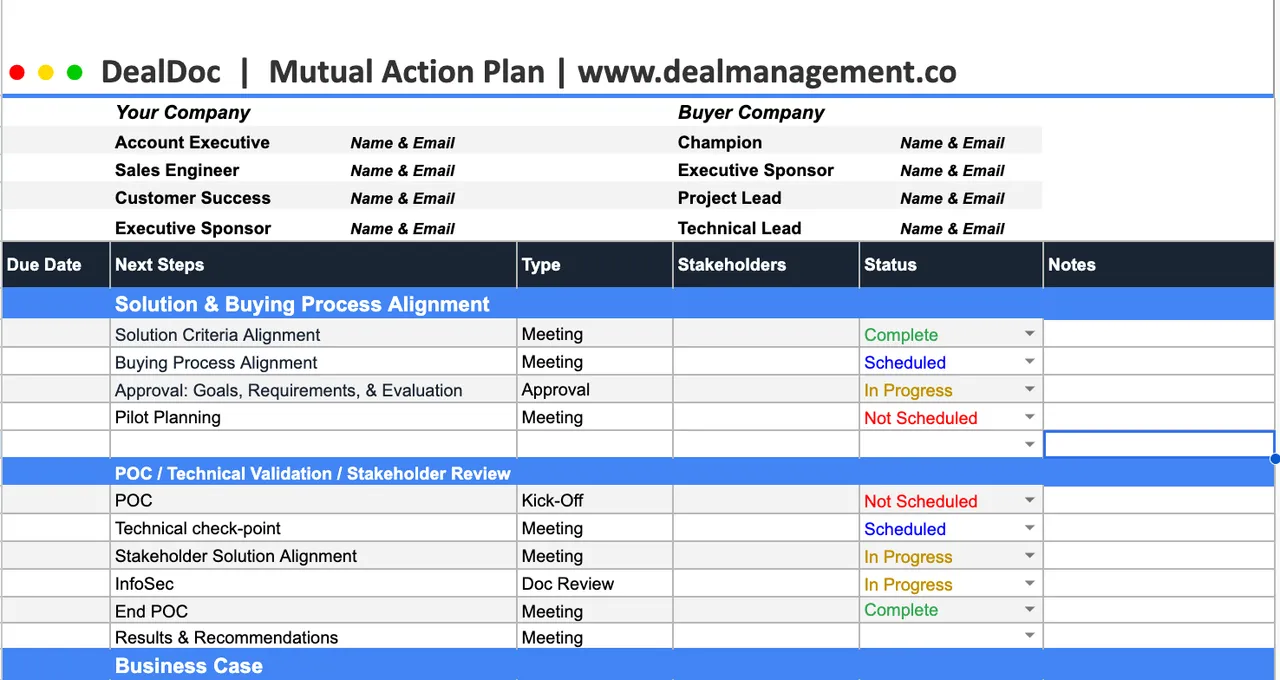
This is the mutual action plan (MAP) template I use to turn “we’re ready” into a signed agreement.
Forecasts usually miss because the seller forecast the moment the business wanted to buy, not the moment it could buy. Security review, legal, vendor onboarding, procurement and a signer who disappears for a month all add time nobody mapped.
A MAP makes that path visible so it can be managed.
What’s in the template
A header with both teams named. Your account executive, sales engineer, customer success lead and executive sponsor on one side. The buyer’s champion, executive sponsor, project lead and technical lead on the other.
Milestones, with the next-step actions under each one. The milestone is the outcome. The actions are the prerequisites that make it real. The template comes pre-built with five milestone groups:
- Solution and buying process alignment: solution criteria alignment, buying process alignment, approval of goals, requirements and evaluation, pilot planning.
- POC, technical validation and stakeholder review: POC kick-off, technical checkpoint, stakeholder solution alignment, InfoSec review, end of POC, results and recommendations.
- Business case: three reviews in order: your champion, then the buying team, then the executive sponsor.
- Contracting: contracting kickoff, redlines and legal, redline reviews, final negotiation, execution.
- Implementation and onboarding: kick-off call and onboarding steps.
Columns for due date, type, stakeholders, status and notes, with status options for complete, scheduled, in progress and not scheduled.
How to use it
- Start from the date that matters and work backwards. Usually the compelling event or the go-live date. Map every step to get there, business steps and paper steps.
- Build it live with the buyer. Not for them. Ask, “How does that compare to how it works in your company, and what would you change?”
- Share it right after the call and ask for edits. Then treat it as the source of truth in every deal update.
- Run a short weekly check-in on plan progress only: completed steps, blockers, next actions, owners and dates.
- When something slips, update the plan. Don’t debate optimism. Surface what moved and agree on the next actions to get back on track.
Progress is not a stage change. Progress is a completed action that moves a milestone forward.
The two mistakes to avoid
Treating it like a seller checklist. If it isn’t co-created, agreed and referenced by the buyer, it’s just internal notes.
Stopping at “proposal sent.” If your MAP doesn’t include security, legal, procurement, vendor onboarding and signature authority, you’re still forecasting intent, not execution.
For the full method, including the working-backwards script and the $30M deal that taught me to map the paper lane, read What Is a Mutual Action Plan in Sales?