A field manual for complex B2B sales
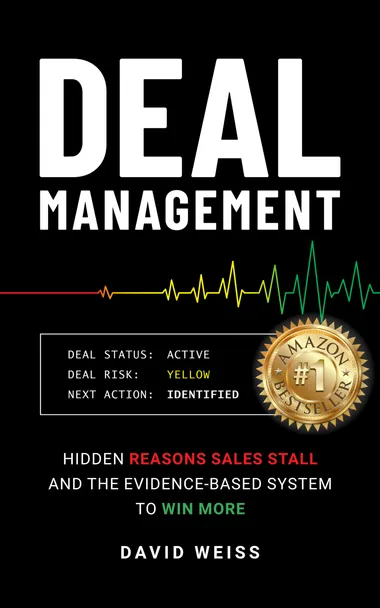
Deal
Management
The Hidden Reasons Sales Stall and the Evidence-Based System to Win More
Most teams run deals on stages and optimism. Deal Management runs deals on criteria, evidence and action, so sellers and leaders can identify risk earlier, close gaps faster, engage the right stakeholders and build a narrative that survives the conversations you're not in.
DAVID WEISS · 2026 · HARDCOVER ISBN 979-8-9955851-4-5
The demo went well. Then nothing.
You've seen it. Discovery felt strong. The demo landed. The buyer said they liked it. The deal moved to "commit." Then the timeline evaporated. The deal drifted. "We're aligning internally." "Revisit next quarter."
It usually isn't one big issue. It's a few unidentified risks and unclosed gaps that don't show up until late, when action no longer matters. And most teams don't have a repeatable way to answer:
What's true, what's assumed, what's missing, and what do we do next?
Deal Management fixes that.
Battle-tested reality
No pep talk. No acronym worship. No classroom theory.
This isn't a motivational book. It's a field manual. Deal Management works alongside whatever your team already uses: MEDDPICC, Challenger, Sandler or a homegrown process. It doesn't replace your stages. It upgrades how you run them.
Most sales processes are a timeline of meetings. Deal Management is a system of action that helps you:
- Identify risk early, before it becomes a forecast surprise
- Close gaps with specific behaviors and plays
- Move the deal story from field to middle to top
- Build a portable narrative so momentum survives internal handoffs
- Improve forecast integrity by grading evidence, not confidence
The six criteria
The six criteria that decide if a deal is real
Every complex deal can be inspected through these criteria. If any of them are weak, the deal will stall, slip or die, even if the meetings are happening.
- 01Current StateDo we know what's happening today, with defensible impact?
- 02Desired Future StateDo we know what "better" looks like, in outcomes they'll actually buy?
- 03Change JustificationCan they defend why this matters now, versus later, versus never?
- 04StakeholdersDo we have the right functions involved, and the right behaviors: coach, champion, blocker?
- 05Buying ProcessDo we know the real path from interest to signature, including the paper lane?
- 06CompetitionDo we know what we're truly competing against, including the status quo?
Stages tell you where the deal is "supposed" to be. Criteria tell you whether the deal is real, and what's missing to win it.
How you see risk
If you can't see risk, you can't coach it.
Deal Management uses simple color coding so sellers and leaders can see the truth of a deal at a glance, and decide what to do next.
We don't know. It's missing.
We think we know. It's an assumption.
We know. It's validated with evidence.
Having red or yellow isn't failure. Pretending it's green is.
The portable narrative
Most deals die in conversations you're not invited to.
A key reason deals stall is that the seller's story only works in live meetings. It doesn't travel. The book shows you how to build a portable narrative, a buyer-shareable story that:
- Captures the real impact of the current state
- Makes the case for change in language stakeholders can repeat
- Keeps urgency intact across internal handoffs
- Helps your champion sell when you're not there
"A good narrative doesn't just persuade your contact. It survives the next conversation without you in the room."
What you'll walk away with
- Diagnose deal reality fastKnow what is true, what is assumed, what is missing and what is wrong.
- See risk earlierMake your deals pre-mortem, not post-mortem.
- Close gaps with the right behaviorsStop "checking boxes" and start running actions that create movement.
- Engage the right stakeholdersMove the deal story from field to middle to top, instead of dying in the middle.
- Build buyer-facing assets that travelCreate alignment that survives internal handoffs and internal debate.
- Improve forecast integrityReplace opinion-based commits with evidence-based commits.
What's inside
Three sections. One operating system.
- 1
Deal Criteria
Defines the six criteria, the traps that create stalls, the color-coded evidence model, and the plays to close gaps before the deal closes itself.
- 2
Deal Management Through Your Sales Process
Applies the criteria stage by stage so sellers know what "good" looks like in discovery, demo, alignment, go/no-go, proposal, negotiation and close, without turning it into CRM admin.
- 3
Operating Rhythms
Shows how to make it stick with seller, manager, team and executive rhythms that turn this into behavior, not a one-time training event.
This book was written for you if…
Account Executives
Your close dates keep slipping and deals go quiet late.
Sales Managers
Your 1:1s feel like status updates, and your pipeline is full of maybes.
CROs & VPs of Sales
You need a way to separate real deals from hope, and improve forecast reliability.
Sales Engineers & Solutions Consultants
Your demos are strong, but the deals still stall.
Enablement & RevOps
You've trained methodology, but adoption is inconsistent and behavior doesn't change.
If you sell complex deals with multiple stakeholders and real internal process, this system applies.
About the author
David Weiss
David Weiss spent 20+ years selling and leading in complex B2B environments. He has sold and supported over $100M in revenue across 10,000+ deals and built this system from the patterns that consistently separate winnable deals from stalled ones. He wrote Deal Management to give sellers and leaders a repeatable way to see risk, close gaps and win more deals on purpose.
More about David →"You don't have a timeline. You have hope. You don't have a champion. You have a friendly contact."
FAQ
Frequently asked questions
What is deal management?
Deal management is the practice of running every opportunity on evidence rather than hope. In the book, David Weiss presents it as an operating system: you assess each deal against six criteria, grade what you actually know with color coding, and take specific actions to close the gaps while there is still time. It works inside your existing sales process, so you do not need to redesign your stages to start using it.
What are the six deal criteria?
The book argues that every B2B deal rests on six criteria: Current State (the verified, quantified reality today), Desired Future State (a concrete picture of what better looks like), Change Justification (why they will prioritize change now rather than later or never), Stakeholders (every buying and influence center the decision needs), Buying Process (the real path to signature, including legal and procurement), and Competition (everything competing for the change, including the status quo).
How is Deal Management different from MEDDICC or MEDDPICC?
It is not a replacement methodology. Weiss credits MEDDPICC as the start of his own journey, but the book is methodology-agnostic: it works with MEDDICC, MEDDPICC, Challenger, SPIN, Sandler, or no formal methodology at all. Each criteria chapter shows how those frameworks label the same idea. Deal Management sits on top as the connecting layer, adding color coding, plays, and operating rhythms so the methodology you already have gets used in live deals.
What does the red, yellow, and green color coding mean?
Each criterion is graded by the strength of the evidence behind it. Red means you don't know and the information is missing. Yellow means you think you know but it is still an assumption the buyer hasn't validated, or there is a known misalignment you are accepting as risk. Green means you know and can prove it with names, dates, numbers, documents, or explicit confirmation. Red and yellow aren't bad; calling something green when it isn't is.
Who is this book for?
Anyone who carries a number, leads people who do, or supports them: account executives, sales managers, revenue leaders and CROs, sales engineers and solution consultants, and enablement and RevOps teams. Individual sellers are encouraged to read it front to back. Sales leaders are pointed to the About the Book section first, then straight to Section 3 on operating rhythms, and back to Sections 1 and 2 as coaches.
Is Deal Management only for enterprise sales?
No. The book applies to any complex B2B sale, whether you sell software, services, hardware, or something else, as long as deals involve multiple stakeholders and medium to long buying cycles. The six criteria stay the same at every deal size. What changes is the evidence bar and the stakeholder complexity: smaller deals move faster because fewer people need to align, while larger deals take more loops through discovery and demo.
How does a sales team roll out Deal Management?
The book recommends a crawl, walk, run approach instead of launching everything at once. Start with the six criteria and color coding, with the team grading a few live deals together. In month one, require color-coded prep for 1:1s and deal reviews. In months two and three, tighten forecast definitions so nothing is Commit unless it is green across all criteria. By quarter two, it becomes the shared language of 1:1s, deal reviews, forecast calls, and QBRs.
What formats is the book available in?
Deal Management is available in hardcover (ISBN 979-8-9955851-4-5) and as a Kindle ebook, both on Amazon. It was published on June 1, 2026, under the DealDoc imprint. There is no paperback edition. The book also points readers to companion resources at dealmanagement.co, including color coding cheat sheets, business case and mutual action plan templates, and one-page checklists for each deal criterion.
Stop guessing. Start knowing.
Every deal you run from here is either evidence-based or hope-based. This book changes which one it is.
Deal Management: The Hidden Reasons Sales Stall and the Evidence-Based System to Win More · David Weiss · 2026 · Hardcover · ISBN 979-8-9955851-4-5