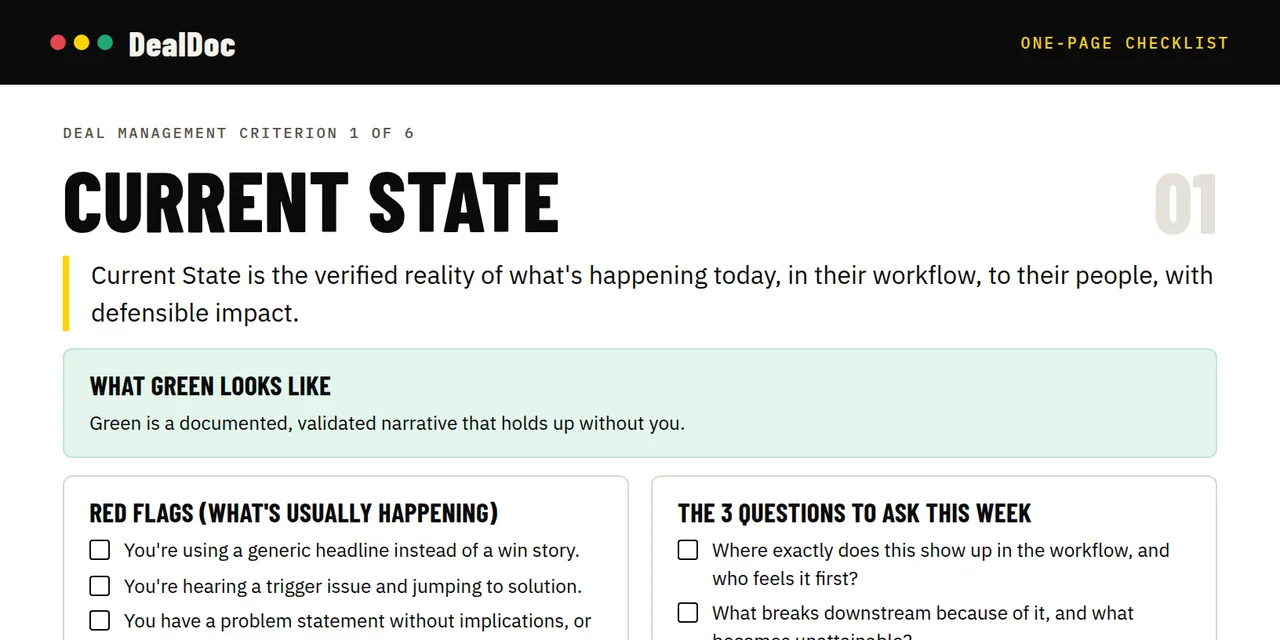
The book promised one-page checklists for each deal criterion. Here they are.
Every deal is governed by six criteria. Each one has real depth behind it, and each one has a way it quietly goes wrong. These checklists put what “good” looks like for each criterion on a single page you can print, share or keep open in a deal review.
What’s on each page
Each of the six pages covers one criterion with the same structure:
- The definition, so everyone grades against the same thing.
- What green looks like: the standard for “we know.”
- Red flags: what’s usually happening when the criterion is weaker than you think, as a checklist.
- The three questions to ask this week.
- The document that should exist, because if it isn’t documented, it isn’t real.
- The color code standard: what red, yellow and green mean for that criterion.
- A “this deal” box for the account, stage, today’s color, the evidence, and the next action with an owner and a date.
The six criteria
| Criterion | The short definition |
|---|---|
| Current State | The verified reality of what’s happening today, in their workflow, to their people, with defensible impact. |
| Desired Future State | A tangible picture of what “better” looks like in their environment, defined as clear needs and clear outcomes. |
| Change Justification | The reason they’ll prioritize change now vs. later vs. never, in a way an executive would defend. |
| Stakeholders | All the needed buying and influence centers to create a change-based decision. |
| Buying Process | The real path from interest to signature: the business decision steps and the legal and commercial steps. |
| Competition | Every force impacting change now with you: status quo, internal build, named competitors, and competition for resources and priority. |
How to use them
- Pick your top five deals.
- Color code each criterion red, yellow or green, honestly.
- For every red or yellow, open that criterion’s page. Check the red flags, ask the three questions, and see whether the document that should exist actually does.
- Pick one action per gap and put an owner and a date on it.
A few examples of the standard: Current State is green when it’s “documented, validated, defensible, shared across stakeholders.” Buying Process is green when there’s a co-created mutual action plan with both lanes mapped, owners and dates confirmed, and progress tracked by completed actions. Anything less is yellow at best.
Pair these with the stage cheat sheet to see how green each criterion should be at each stage, and read The Deal Qualification Framework Nobody Taught You for the full system.